
Contemplative Research
Scroll to the bottom for more categories.
Meditation and the Sense of Self
Meditation is known to lead to profound alterations in the sense of self. While many practitioners describe transformative benefits, a significant proportion report confusion, distress, or lasting psychological disruptions such as dissociation or depersonalization. A key challenge for contemporary meditators is how to reconcile competing cultural models of the self. While Buddhist-inspired frameworks often emphasize self-transcendence and self-dissolution, Western psychological models tend to prioritize self-development and integration. However, little research has examined how practitioners navigate these conceptual and pragmatic tensions in their own experience. This study investigates how beliefs about selfhood influence meditative experiences and contribute to either transformative insight or psychological distress. Combining ethnographic and phenomenological methods, we are developing systematic tools for analyzing how meditators interpret, integrate, and manage shifts in self-experience. The findings will clarify how beliefs about the self shape embodied experiences of selfhood, and inform best practices for supporting psychological safety and well-being in the growing field of meditation.
Energy-like Somatic Experiences and Subtle Body Interpretive Frameworks
Meditation practitioners, historically and today, sometimes report experiencing energy‑like sensations in their body. While recent empirical studies have explored such experiences in the context of Buddhist and Yogic practice, no comparable research has yet examined energy‑like sensations in Jewish, Christian, or Islamic traditions. Based on interviews with 30 practitioners and 30 teachers from Abrahamic contemplative traditions and found that energy‑like somatic experiences were common within our sample. Twelve practitioners (40%) spontaneously reported having experienced at least one, and thirteen teachers (43%) described them occurring either personally or to their students and colleagues. These experiences occurred along a continuum of intensities and valences, with interpretations ranging from anticipated signs of progress to striking unexpected events. Participants drew on a variety of metaphors and frameworks to make sense of these experiences. They often blended ideas from multiple traditions and mixed concepts from spiritual and psychological explanatory models. When comparing these descriptions from our sample to those reported by Western Buddhists in earlier research, we observe notable commonalities as well as differences in the patterns of energy‑like experiences across these traditions. Our findings suggest that energy‑like somatic experiences emerge through a complex interaction of cultural and bodily processes, where interpretive frameworks interact with attentional and biological processes to determine the specific phenomenology and outcomes of these energetic sensations.
Jhana meditation and advanced concentration
We use computational modeling and EEG neurophysiological measures to investigate advanced states of concentration, focusing on jhāna meditation—a canonical Buddhist practice involving deep absorption and sensory withdrawal. By combining subjective reports with neural complexity metrics and prediction error signals, we bridge phenomenology and neurophysiology to understand how consciousness deconstructs under conditions of high attentional stability. Our findings show that jhāna induces sensory fading while increasing neural entropy and enhancing early sensory prediction errors (MMN), suggesting a unique state of high entropy with preserved precision. This research is conducted in close collaboration with meditation teacher Shaila Catherine and involves some of her most advanced students. It is part of an ongoing effort to study expert contemplative practice, with additional retreat-based data collection planned to expand this work.
Mechanisms of Mindfulness-Based Cognitive Therapy
Mindfulness-based interventions have emerged as efficacious and cost-effective non-pharmacological treatments for depression; however, the psychological mechanisms remain unclear. A reduction of self-related processing has been proposed as a key mechanism of mindfulness-based interventions, given that negatively valenced self-concept is one of the most robust cognitive signatures of clinical depression. However, the “self” is a complex, multifaceted construct, and the various self-related processes targeted in mindfulness interventions—e.g., “decentering”, “self-concept”,“narrative self”— often remain underspecified in mindfulness research.
Inspired by the Buddhist idea that self-grasping causes suffering, researchers commonly suggest that mindfulness-based interventions may differ from other treatments by “prioritizing disidentification and reduction in all forms of SRP [self-related processing], positive as well as negative” (Alejandre-Lara et al 2022, p. 3). Others, however, have challenged this perspective (Britton et al. 2021). Though strong evidence supports the clinical benefit of disidentifying from negative self-evaluative thoughts, it is far from clear that disidentifying from positive self-related processes is also clinically beneficial. In fact, the strengthening of some self-related processes such as positive self-concept and narrative coherence may actually be the most critical mechanisms in mindfulness-based interventions for depression. In this study we are examining this hypothesis by disentangling the role of different self-processes in a clinical trial of mindfulness-based cognitive therapy (MBCT) for late-life depression.
Tulpamancy
Tulpamancy is the practice of training the imagination to create invisible mental companions called “tulpas”. Tulpas are understood to share the mind and body of the person who created them, but to have their own free will and agency. Originally inspired by “Illusory Form” practices from the Dream Yoga traditions of Tibet, a secular form of tulpamancy has been gaining popularity over the past decade through online message boards and chat servers. In our ongoing multi-methods project, we combine phenomenological interviews and functional neuroimaging to investigate the cognitive mechanisms and potential therapeutic merits of tulpamancy. This research illustrates how imagination-based techniques can open new modes of subjectivity and pattern fundamental aspects of human experience—right down to the basic feeling of agency over our innermost thoughts and actions.
Prayer
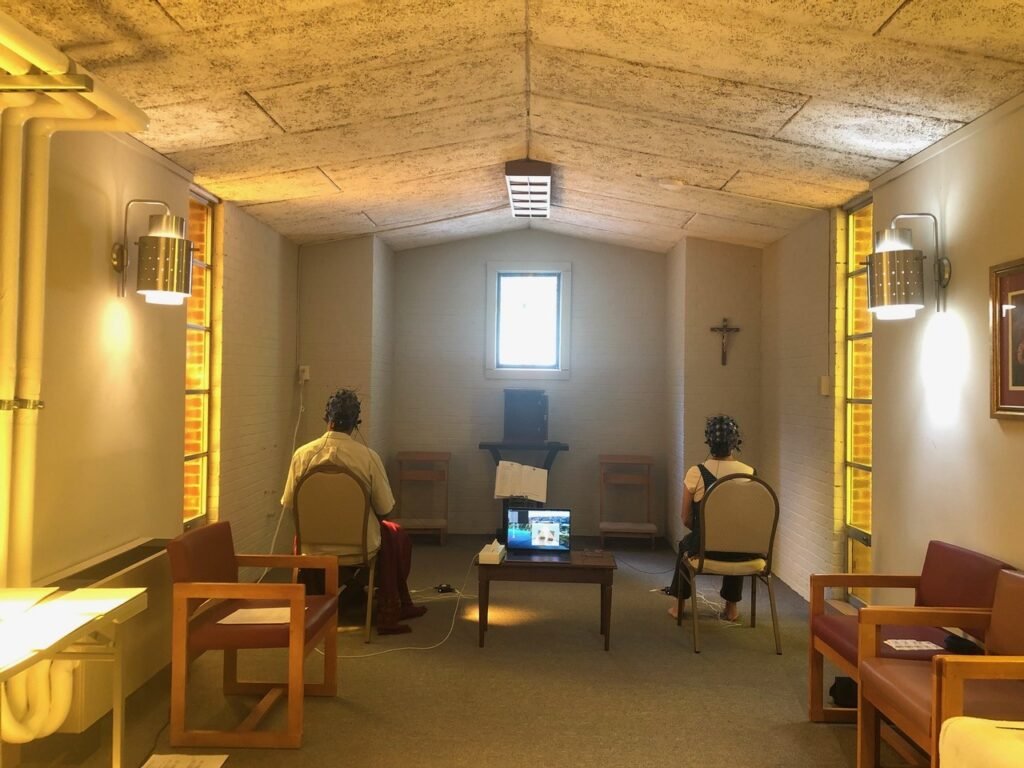
Prayer is often viewed in contemplative science as analogous to mindfulness—a means of relaxation and mental quieting. This framing has contributed to a relative lack of research on prayer itself, particularly Christian forms. Our work addresses this gap by examining the lived experience and neural dynamics of Christian prayer, from quiet praise to the high-arousal states of speaking in tongues. While prayer takes many forms, our findings suggest a shared mechanism: the invitation to surrender control to a higher power. Ecstatic prayer can involve vivid imagery, intense emotional engagement, ego-dissolution, and renewal, with deeper surrender linked to loosening cognitive patterns. Prayer may calm the mind either by gently releasing intrusive thoughts or by generating a mental “white noise” that displaces them. Currently, we are investigating how prayer compares to other contemplative practices, and how set and setting, especially in diverse church contexts, shape the emergence of compassion often reported during prayer.
Psychedelic entity encounters
We use computational modeling—specifically the Active Inference framework—to explore the structure of phenomenal experience. This work contributes to a growing effort to formalize phenomenology within neuroscience by modeling how hierarchical, precision-weighted inference can generate altered states of consciousness. As part of this broader endeavor, we are currently co-editing a special issue on computational approaches to phenomenology for the Neuroscience of Consciousness, led by Jonas Mago. In our contribution, we apply this framework to understand the experience of encountering seemingly autonomous entities, as often reported under the influence of psychedelics.
Dyadic studies of prayer and meditation
Coming soon…
How Nature Tunes the Mind
This project investigates how natural environments influence human experience through rhythmic attunement between brain, body, and world. Using EEG, heart rate variability, respiration, and cortisol measures, combined with microphenomenological interviews, we examine how people synchronize with the fractal and oscillatory patterns of natural stimuli such as waves and forest canopies. Virtual reality allows precise manipulation of sensory input, while real-world fieldwork ensures ecological validity. Our analyses link neural and physiological coupling with subjective states of awe, unity, and presence, exploring how individual traits and beliefs modulate these effects. By bridging neuroscience, phenomenology, and ecology, this research extends contemplative science into ecological contexts, showing how nature itself can act as a contemplative partner and laying groundwork for interventions that foster resilience, ecological awareness, and care